
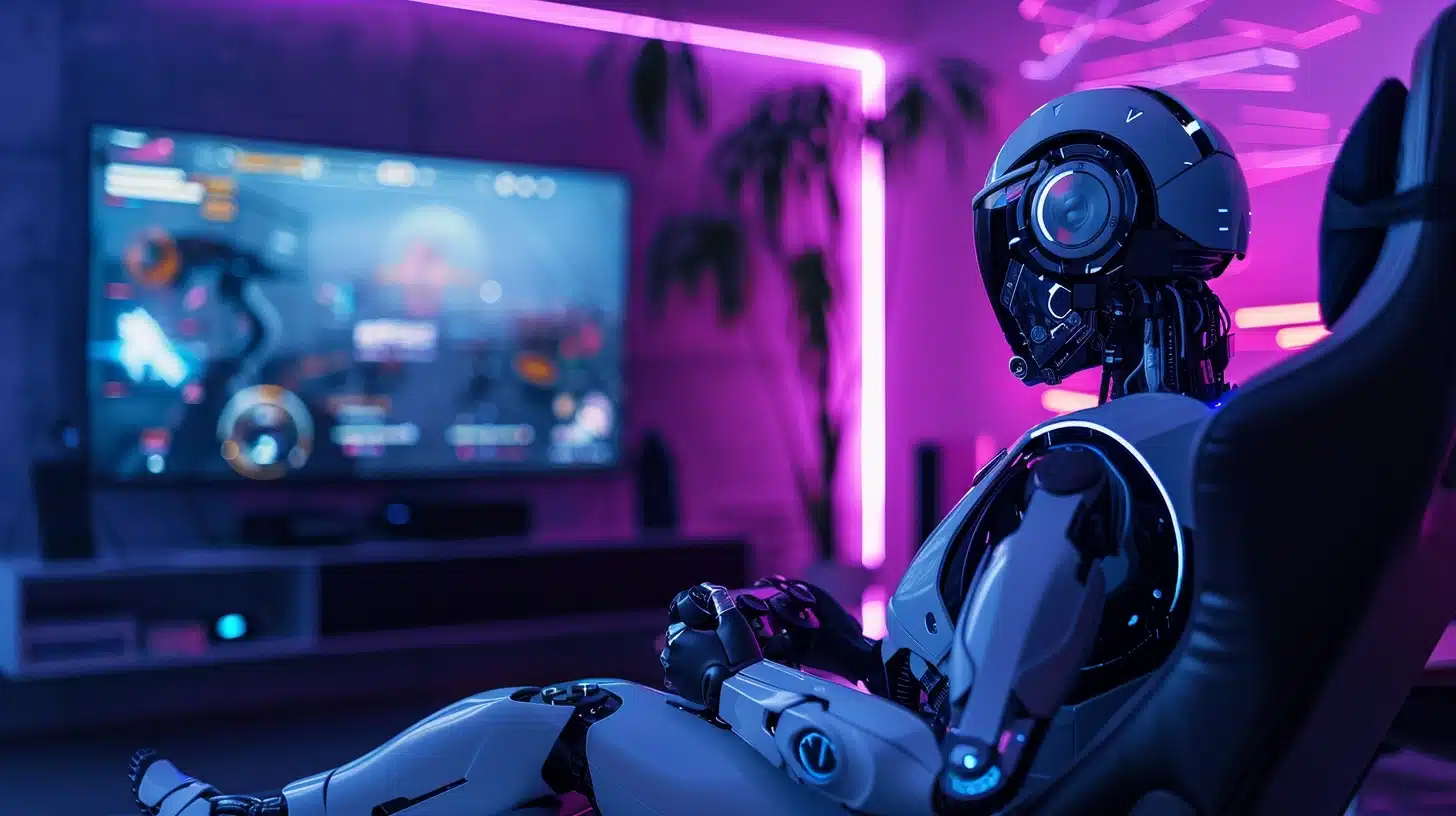
AI in Gaming 2026 – Future of Video Games Explained
316 views
Introduction
Artificial Intelligence (AI) is no longer just a background tool in gaming—it has become a central force shaping how games are created, played, and experienced. In 2026, the gaming industry is undergoing one of its biggest transformations, driven by rapid advancements in machine learning, generative AI, and real-time simulation technologies. What once felt like scripted entertainment is now evolving into dynamic, intelligent, and highly personalized experiences.
Today’s games are no longer static. Characters can learn, worlds can evolve, and stories can adapt to each player. This shift is not just improving graphics or gameplay mechanics—it is redefining what a video game actually is.
According to recent industry insights, around 50% of game studios now actively use AI in development, and a growing portion of new games include AI-driven systems . At the same time, the AI gaming market is expected to grow rapidly, with billions of dollars in expansion over the next few years . This shows that AI is not a trend—it is the future of gaming.
The Evolution of AI in Gaming
AI has been part of video games for decades, but earlier systems were quite simple. Non-player characters (NPCs) followed pre-written scripts, reacting in predictable ways. For example, enemies would follow fixed paths, and allies would respond based on limited conditions.
Modern AI has changed this completely.
Instead of relying only on scripts, developers now use advanced systems such as:
- Machine learning
- Neural networks
- Behavior modeling
- Reinforcement learning
These technologies allow game characters to adapt, learn, and respond dynamically to player actions .
In 2026, this evolution has reached a turning point. AI is no longer just supporting game design—it is actively shaping gameplay itself. Games are becoming more like living systems rather than fixed experiences .
Smarter NPCs: From Scripted to Intelligent
One of the biggest changes in AI gaming is the transformation of NPCs.
In older games, NPCs often repeated the same lines and behaved in predictable ways. In 2026, NPCs are becoming far more realistic and interactive.
What makes modern NPCs different?
Modern AI-powered NPCs can:
- Remember past interactions
- Adapt their behavior based on your play style
- Show emotional responses
- Make independent decisions
Some systems even allow NPCs to develop consistent personalities and relationships over time, making them feel closer to real characters .
A recent study found that 96% of players enjoy AI-powered NPCs, highlighting how important this feature has become in modern gaming .
Additionally, new experimental concepts such as “agent-based games” are emerging. In these games, AI characters are not just reacting—they are actively participating in the world, sometimes even refusing player commands or acting on their own goals .
This level of intelligence creates deeper immersion and makes every gameplay session unique.
Generative AI and Dynamic Game Worlds
Another major innovation in 2026 is generative AI.
Generative AI allows games to create content automatically, including:
- Environments
- Missions
- Characters
- Storylines
- Music and sound
Instead of developers designing every detail manually, AI can generate vast worlds and experiences in real time.
This leads to:
- Larger and more diverse game worlds
- Endless replayability
- Personalized content for each player
For example, a game might generate a completely new quest based on your previous decisions, or create a world that evolves even when you are offline.
Generative AI is also helping developers build games faster and more efficiently. It reduces repetitive tasks and allows teams to focus more on creativity .
However, it is important to note that many studios still combine AI with human creativity. Even in 2026, human designers remain essential for storytelling, emotional depth, and artistic direction.
AI-Driven Personalization
Personalization is one of the most powerful aspects of AI in gaming.
Modern AI systems can analyze player behavior, including:
- Play style
- Skill level
- Preferences
- Decision patterns
Based on this data, games can automatically adjust:
- Difficulty levels
- Story paths
- Enemy behavior
- Game pacing
This creates a more balanced and enjoyable experience for each player.
For example, if a player struggles with a certain level, the AI may reduce difficulty or offer subtle guidance. On the other hand, experienced players may face more complex challenges.
This type of adaptive gameplay was not possible in traditional games. Now, it is becoming a standard feature.
AI in Game Development: Faster and Smarter Creation
AI is not only changing how games are played—it is also transforming how they are made.
Game development has traditionally been expensive and time-consuming. Large teams would spend years building assets, testing systems, and fixing bugs.
In 2026, AI is helping developers:
- Automate testing processes
- Generate assets and animations
- Balance gameplay mechanics
- Reduce development time
This allows studios to create high-quality games with fewer resources. In fact, some companies have already used AI tools to produce successful games with smaller teams and lower costs .
However, this shift also brings challenges. While AI can improve efficiency, it raises questions about creativity, job roles, and the balance between automation and human input.
AI and Graphics: A New Level of Realism
AI is also revolutionizing graphics and performance.
Recent innovations show how AI can improve visual quality while reducing hardware requirements. For example:
- AI-based texture compression can reduce memory usage significantly
- AI-generated frames can increase frame rates
- Real-time upscaling improves image quality
One new technology demonstrated that AI could reduce VRAM usage by up to 85% without losing visual quality, making games more efficient .
Another advancement allows GPUs to generate additional frames using AI, increasing performance dramatically while maintaining smooth gameplay .
These improvements mean that future games will look better and run smoother, even on less powerful hardware.
Challenges and Concerns of AI in Gaming
Despite its advantages, AI in gaming also brings several challenges.
1. Creative Concerns
Some developers worry that too much reliance on AI could reduce human creativity. Games may feel less unique if they rely heavily on automated systems.
2. Ethical Issues
There are concerns about how AI-generated content is created, especially regarding originality and ownership.
3. Industry Debate
Not everyone in the gaming industry fully supports AI. Surveys show mixed opinions, with some developers seeing it as beneficial while others remain cautious .
4. Rising Costs
Interestingly, AI is also contributing to increased hardware demand, which has made gaming more expensive in some cases .
These challenges show that while AI offers many benefits, it must be used carefully.
The Future of AI in Gaming
Looking ahead, the future of AI in gaming is incredibly promising.
Here are some key trends expected to shape the industry:
Living Game Worlds
Games will continue evolving even when players are offline, creating persistent and dynamic environments.
Fully Interactive Characters
NPCs will become more lifelike, with deeper emotions, memory, and independent decision-making.
AI-Generated Stories
Stories will adapt in real time, creating unique narratives for every player.
Smaller and Smarter AI Models
Future AI systems will be faster, more efficient, and capable of running directly on gaming devices .
Increased Accessibility
AI tools will make game development easier, allowing more people to create games.
At the same time, the industry will need to find a balance between innovation and creativity. The goal is not to replace human developers but to enhance their abilities.
Conclusion
AI in gaming in 2026 represents a major shift in how video games are designed and experienced. From intelligent NPCs to generative worlds and personalized gameplay, AI is transforming gaming into a more immersive and dynamic form of entertainment.
However, this transformation is not without challenges. Developers, players, and companies must carefully navigate issues related to creativity, ethics, and cost.
What is clear is that AI is not just improving games—it is redefining them.
The future of video games will not be about fixed stories or predictable gameplay. Instead, it will be about living worlds, intelligent characters, and experiences that adapt to every player.
In simple terms, games are no longer just played—they are experienced, shaped, and evolved in real time.
And that is what makes AI in gaming in 2026 truly revolutionary.
AI in gaming 2026
future of video games
AI game development
gaming technology trends
smart NPCs
Found this helpful? Share it!